
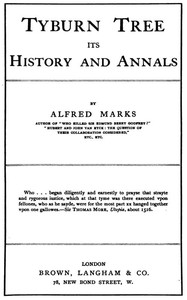
Tyburn Tree: Its History and Annals by Alfred Marks
Ever walked past Marble Arch in London? It’s a busy traffic island now, but for over 600 years, it was the site of Tyburn Tree, the city’s main execution ground. Alfred Marks’s book is the story of that place. He doesn’t just give us dates and names; he rebuilds the world around the gallows, from its simple beginnings to the massive public spectacles it became.
The Story
This isn't a novel with a single plot, but the ‘story’ of Tyburn itself. Marks takes us from the 1100s, when executions started there, through its peak in the 1700s. We see the evolution from a basic wooden structure to the infamous ‘triple tree,’ a three-legged gallows that could hang two dozen people at once. The narrative is built from the lives that ended there: famous figures like the pirate Captain Kidd, the rebel leader William Wallace (Braveheart), and Catholic martyrs, alongside countless unknown thieves and forgers. Marks shows us the chaotic carnival of execution day—the crowds, the vendors, the last speeches, and the grim efficiency of the hangman.
Why You Should Read It
What grabbed me was how human it all feels. Marks has a knack for finding the small, telling details in old court records and pamphlets. You get a sense of the sheer weirdness of it: families having picnics, pickpockets working the audience, and the condemned often being treated like celebrities. It makes you think deeply about justice, spectacle, and how societies deal with crime. It’s not just about the violence; it’s about the community that grew up around it. The book also quietly follows Tyburn’s end, as public opinion turned against these spectacles and the gallows were finally taken down for good in 1783.
Final Verdict
Perfect for anyone who loves London history, true crime, or social history that reads like a story. If you’ve enjoyed books like The Five by Hallie Rubenhold or just want to understand the darker, stranger corners of the past, this is for you. It’s a sobering but completely gripping look at a place where history was literally made, one life at a time. Be warned: it’s not a light read, but it is a profoundly memorable one.
This publication is available for unrestricted use. Distribute this work to help spread literacy.
Susan Thomas
10 months agoThe peer-reviewed feel of this content gives me great confidence.
Charles Brown
2 years agoAfter a thorough walkthrough of the table of contents, the case studies and practical examples provided add immense value. This adds significant depth to my understanding of the field.
David White
8 months agoThe information is current and very relevant to today's needs.
Michael Harris
1 year agoGreat digital experience compared to other versions.
Kimberly Harris
2 years agoI've been looking for a reliable source on this topic, and the narrative arc keeps the reader engaged while delivering factual content. A rare gem in a sea of mediocre content.