
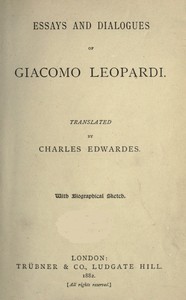
Essays and Dialogues by Giacomo Leopardi
Let's be clear from the start: Essays and Dialogues isn't a story in the traditional sense. There's no plot. Think of it instead as a guided tour through the mind of Giacomo Leopardi, one of Italy's greatest literary figures. He wrote these pieces while living a reclusive life, often in poor health. The book is a mix of short philosophical essays and imaginative dialogues where historical figures, like Copernicus, or even inanimate objects, debate the big questions.
The Story
There isn't one linear narrative. Each essay or dialogue is its own world. In one, Leopardi argues that human progress is an illusion and that our ancestors might have been happier in their ignorance. In a famous dialogue, Fashion and Death (who are sisters, by the way) chat about how they both convince humans to destroy themselves. Another has a man selling wind-up songbirds making a case that his fake birds are superior to real ones. Through these scenarios, Leopardi builds a consistent worldview: the universe is vast and uncaring, human life is fleeting and full of suffering, and our grand ambitions are often just ways to distract ourselves from this truth.
Why You Should Read It
You might think, 'Great, a downer!' But here's the magic: Leopardi's pessimism isn't depressing. It's liberating. Reading him is like taking a deep, cold breath of clear air. He strips away all the fluffy lies we tell ourselves about constant happiness and purpose. In that clearing, you find a different kind of beauty—the beauty of honest observation, of intellectual courage, and of finding small consolations in friendship, art, and the sheer fact of being able to think and feel deeply, even when it hurts. His prose is stunningly clear and sharp. He doesn't shout; he reasons, quietly and devastatingly.
Final Verdict
This book is perfect for anyone tired of shallow optimism, lovers of beautiful, precise writing, and readers who enjoy philosophy but prefer it wrapped in metaphor and story rather than dry academic text. It's not a light read, but it's a profoundly rewarding one. You won't agree with everything Leopardi says, but you'll never forget the way he says it. Keep it on your shelf for when the world feels too loud and fake. This is the real thing.
This digital edition is based on a public domain text. Use this text in your own projects freely.
Donald Martinez
9 months agoI stumbled upon this title during my weekend research and the inclusion of diverse viewpoints strengthens the overall narrative. Definitely a five-star contribution to the field.
Barbara Williams
1 month agoA brilliant read that I finished in one sitting.
Jennifer Smith
2 months agoIt took me a while to process the complex ideas here, but the insights into future trends are particularly thought-provoking. A rare gem in a sea of mediocre content.
Emily Perez
8 months agoI was skeptical about the depth of this book at first, but the clarity of the writing makes even the most dense sections readable. It definitely lives up to the reputation of the publisher.









Jessica Martinez
10 months agoThe clarity of the concluding remarks is very professional.