
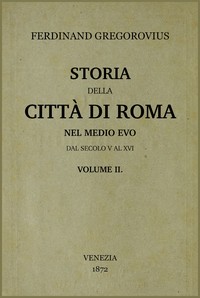
Storia della città di Roma nel medio evo, vol. 2/8 : dal secolo V al XVI
Ferdinand Gregorovius's Storia della città di Roma nel medio evo is a monumental work, and this second volume picks up right after the dramatic collapse of the Western Roman Empire. It covers the chaotic period from the 5th to the 8th centuries.
The Story
This isn't a story with a single plot. It's the biography of a city in crisis. Gregorovius shows us Rome's staggering transformation. The grand capital, once home to over a million people, empties out. The magnificent public buildings, forums, and temples aren't destroyed in a single war; they're slowly abandoned, quarried for stone, or repurposed. The political power shifts dramatically from emperors to popes, but even the Papacy struggles to control the city. The narrative follows a series of invasions—by Goths, Byzantines, and Lombards—but the real enemy often seems to be neglect. The aqueducts fail, the population plummets, and the vast urban space shrinks back to a small community centered around the Tiber. It's a slow-motion unraveling of a civilization.
Why You Should Read It
What makes Gregorovius special is his perspective. He was a German historian who lived in Rome for decades, walking the same streets he wrote about. You feel that intimacy. He doesn't just tell you the Visigoths sacked Rome in 410; he makes you feel the profound psychological shockwave that sent through the ancient world. He connects physical decay with social and political collapse. You see how the Senate fades away, how churches are built into old basilicas, and how the very meaning of 'Rome' changes. It's immersive. Reading this volume is like having a supremely knowledgeable guide take you by the arm and point to a patch of grass, saying, 'See this? This was the heart of the world, and here's how it stopped beating.'
Final Verdict
This is not a casual beach read. It's for the curious traveler, the armchair historian, or anyone fascinated by how great cities live and die. It's perfect for someone who has visited Rome and wants to understand the layers beneath the Renaissance and Baroque splendor. If you enjoy authors like Mary Beard but want to go deeper into the 'Dark Ages,' Gregorovius is your man. Be prepared for detail and a 19th-century prose style (even in translation), but the reward is a profound understanding of one of history's greatest transformations. Think of it as the ultimate prequel to the Rome we know today.
This work has been identified as being free of known copyright restrictions. Preserving history for future generations.
Betty Rodriguez
1 year agoA bit long but worth it.
Ava Jackson
1 year agoVery interesting perspective.
Aiden Sanchez
2 years agoSolid story.



Jessica Robinson
1 year agoLoved it.