
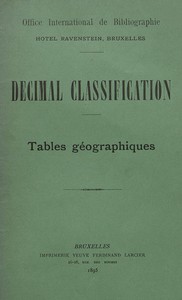
Decimal Classification. Tables géographiques
Let's be clear from the start: this is not a book you read cover-to-cover for a gripping narrative. ‘Decimal Classification. Tables géographiques’ is a manual. Published in 1905 by the International Institute of Bibliography (which would later become the folks behind the Dewey Decimal System), it's a specialized volume detailing how to classify anything related to geography within a library cataloguing system.
The Story
There's no plot, but there is a fascinating project. The book presents a massive, hierarchical list. Every continent, country, region, and major city is assigned a precise decimal number. Need a book on the history of Paris? Look for the number 944.36. Researching the flora of Java? That's 918.2. The 'story' is the sheer, audacious scope of the endeavor. It attempts to impose a rigid, numerical order on the infinitely varied and constantly changing political and physical landscape of our planet. Flipping through it, you see the world as it was politically organized in 1905, frozen in a framework of digits and decimals.
Why You Should Read It
You should dip into this for the historical time capsule it provides. It’s a mirror held up to the early 1900s worldview. You see which places were considered important enough for their own number, and how regions were grouped (often reflecting colonial attitudes of the time). It’s a lesson in how we try to make sense of complexity through systems. There's something almost poetic about seeing human conflict, natural wonder, and cultural achievement all reduced to neat, orderly numerals. It makes you think about all the invisible structures we use to organize information today, and how future generations might look back on our own systems as charmingly archaic.
Final Verdict
This is a niche read, but a rewarding one for the right person. It's perfect for history buffs, library science enthusiasts, or anyone fascinated by how we organize knowledge. If you love old maps, weird reference books, or seeing the hidden skeletons of information systems, you'll find this strangely compelling. It's not a beach read, but as a piece of intellectual history, it's a quiet little marvel. Think of it as a museum exhibit in book form—best appreciated in short, curious bursts.
This title is part of the public domain archive. Enjoy reading and sharing without restrictions.
Joseph Thomas
10 months agoEnjoyed every page.
Ethan Perez
1 year agoI came across this while browsing and the clarity of the writing makes this accessible. A true masterpiece.
Donald Harris
8 months agoTo be perfectly clear, the narrative structure is incredibly compelling. Worth every second.
Michael Jackson
8 months agoI started reading out of curiosity and the plot twists are genuinely surprising. A true masterpiece.







Karen Williams
5 months agoVery helpful, thanks.